In 2025 the United Nations released a report that put a spotlight on cities, stating that 45% of the world’s 8.2 billion people live in urban areas and projecting that two-thirds of global growth will occur in cities over the next 25 years. And yet, the United Nations also argues that rural development is a critical global concern.
In fact, what happens in rural localities will make or break our ability to meet the 17 Sustainable Development Goals (SDGs), established by the United Nations in 2015, that provide benchmarks for “ending poverty, protecting the planet and tackling inequalities.” Here’s why:
Poverty & Inequality: 80% of the world’s poorest people live in rural areas, ½ are children and ½ lack health coverage.
Agriculture and Food Security: 80% of the world’s food is grown on family farms. Women make up 43% of the agricultural workforce but face significant barriers to land, credit, technology.
Climate: Rural communities are on the frontlines of climate change – droughts, floods, extreme heat. A UN goal – create climate resilient livelihoods – and water management is a key issue here.
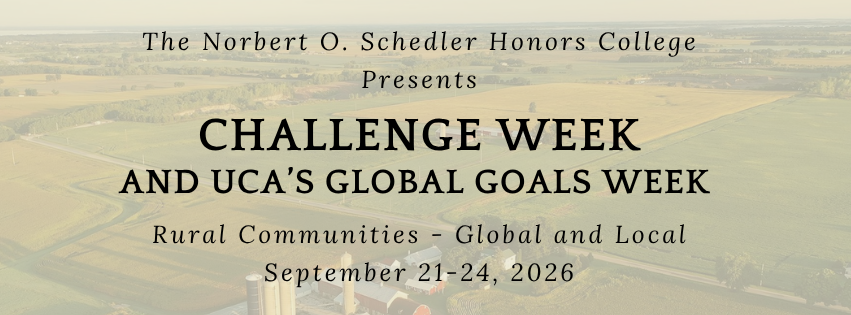
The goal of this year’s Challenge Week is to explore a diverse range of rural issues from a diverse range of perspectives, hearing from people who are working in our own backyard, our region, across the United States, and internationally. We’ll explore economic and community development, literacy, environmental justice, and sustainable local food systems, spotlighting individuals working to make a positive change.
Schedule-at-a-Glance
Monday, September 21, 5:00-6:00 pm (with refreshments starting at 4:30 pm) Student Center 205
“Rural Community Development” with Julianne Dunn.
SDG Goals: 1: No Poverty | 3: Good Health & Well-Being | 8: Decent Work & Economic Growth | 11: Sustainable Cities & Communities | 16: Peace, Justice, & Strong Institutions
Rural communities are at the forefront of some of the world’s most significant challenges and greatest opportunities. Often serving as the “canary in the coal mine,” they often experience emerging issues before larger communities do while also pioneering innovative, resourceful solutions. From addressing workforce shortages and adapting to a rapidly changing economy to expanding access to essential services and strengthening disaster preparedness and recovery, rural economic development takes a holistic approach to building resilient communities.
Drawing on real-world examples from communities across the country, Julianne will explore how rural economic development professionals work alongside local leaders to develop practical, community-driven strategies that reflect local needs and assets. Attendees will be challenged to consider how their own skills and interests can contribute to strengthening rural communities and creating lasting, meaningful impact.
Julianne Dunn is the Senior Program Officer, Workforce and Financial Prosperity, with Rural LISC (Local Initiatives Support Corporation). Dunn manages a comprehensive portfolio of community and economic development programs, including the Rural Works program, a workforce development initiative that leverages the momentum of rural communities to reimagine and redevelop the workforce ecosystems that impact their communities, as well as the financial literacy education and coaching community, small business and entrepreneurship development network, and rural Safety & Justice programs. She works to align the workforce, financial capability, business development and retention, and justice efforts, and to highlight the innovations and challenges of rural markets to foster a 21st century economy.
Previously she served as the Instructor-Economic Development for the University of Arkansas System Division of Agriculture Community, Professional, and Economic Development, primarily leading a rural economic development project focused on retail and tourism. Additionally, she served as the Assistant Director of Field Service for the Clinton School of Public Service, as a Facilitation Coach for UFacilitate, and as a Peace Corps Volunteer in Ukraine. Julianne has a B.A. in political science from the University of Missouri-Kansas City, a Masters of Public Health from the University of Arkansas for Medical Sciences College of Public Health, and a Masters of Public Service from the University of Arkansas Clinton School of Public Service.
Tuesday, September 22, x-period, 1:40-2:30 pm (with refreshments after) COB Auditorium
“Heart Work: How Community-Accountable, Black Feminist Love Ethics Guide the Arkansas and National Literacy Advocacy of the Community Literacies Collaboratory” with Dr. Eric Darnell Pritchard
SDG Goal 4: Quality Education
What happens when we make space for ancestor-led, community accountable, Black feminist love ethics as the heart work through which we tell new stories – and create new key concepts – in the work of literacy advocacy wherever that work takes place whether rural or metropolitan? In this presentation, Dr. Eric Darnell Pritchard will discuss the community literacies advocacy as envisioned and practiced by The Community Literacies Collaboratory (CLC) and its commitment to support Arkansans and all people practice literacies more fluently, richly, productively, and joyfully. A university-affiliated community literacies center, the CLC facilitates and supports literacy programs ranging from scholarly research and educational and policy initiatives to community programming centered on empowerment and advocacy. To date, the CLC’s work has resulted in collaborations with Arkansas literacy practitioners across 21 counties (and counting). Through workshops and its grants program, the CLC has shared this Arkansas based model with literacy practitioners nationally including in California, Florida, Iowa, Mississippi, New York, and Texas. At its core, as with Pritchard’s award-winning scholarly work, the CLC is driven by Black feminist love ethics as defined by an intergeneration of Black feminist community educators, an ethics Pritchard has conceptualized as “heart work” to characterize the innovative ways the CLC invite, sponsor, and sustain collaborative community practices among various literacies stakeholders in Arkansas and nationally.
Dr. Eric Darnell Pritchard is an award-winning author, cultural critic, and educator whose writing, teaching, and community-accountable collaborations center on literacy and its connections to popular culture, identity, and power. They are the Brown Chair in English Literacy and Associate Professor of English at the University of Arkansas in Fayetteville where they are also Founding Director of the Community Literacies Collaboratory (CLC). A center that promotes literacy in all its forms through scholarly research, policy initiatives, advocacy, and community engagement, the CLC activates this work through a vision centered on an ethics of justice, imagination, community accountability and love. Author of the award-winning book Fashioning Lives: Black Queers and the Politics of Literacy, and most recently, their debut picture book biography, Clothes to Make You Smile: Patrick Kelly Designs His Dreams, Dr. Pritchard’s writings have appeared in numerous scholarly and popular volumes including The New York Times, Harvard Educational Review, The International Journal of Fashion Studies, Public Books and Ebony Magazine. They have also been quoted as an expert in publications including The Wall Street Journal, VOGUE Magazine, and The Guardian. Eric has also authored several essays in catalogues for fashion and contemporary art exhibitions at numerous museums including Cooper Hewitt Smithsonian Design Museum, The de Young Museum, The Museum at the Fashion Institute of Technology, and the Fuller Craft Museum. Their next book, Adorn: The Tenacious Life and Joyful Work of Patrick Kelly, an adult nonfiction biography about the 1980s fashion design superstar, is forthcoming later this year from W.W. Norton & Company.
Wednesday, September 23, 5:00-6:00 pm (refreshments at 4:30 pm) COB Auditorium
“We Are All in Harm’s Way” with Catherine Coleman-Flowers
SDG Goals: 6: Clean Water & Sanitation | 10: Reduced Inequalities | 13: Climate Action | 16: Peace, Justice, & Strong Institutions
This event is supported by SGA’s SAFA, the Department of Health Sciences, and the College of Health and Behavioral Sciences
Race does not shield one from the injustice of environmental harm. Numerous communities are impacted by environmental harm whether from sanitation issues or data centers. The answer lies in rural ingenuity. This talk discusses problems and solutions from a country girl’s perspective.
Catherine Coleman Flowers is the founder and CEO of the Center for Rural Enterprise and Environmental Justice (CREEJ) and one of the nation’s most influential voices on environmental justice and rural poverty. She holds an honorary Doctor of Environmental Science from Wesleyan University and has been recognized with some of the world’s most prestigious honors, including the MacArthur “Genius” Fellowship, TIME 100, Forbes 50 Over 50, Forbes Inaugural 50 Global Leaders in Sustainability, and the 2025 TIME Earth Award.
Flowers serves on the Broadway Green Alliance Advisory Council and sits on the boards of The Climate Reality Project and the Natural Resources Defense Council, helping shape national and global climate strategy.
She is the author of Holy Ground: On Activism, Environmental Justice, and Finding Hope and Waste: One Woman’s Fight Against America’s Dirty Secret. Both books received the Southern Environmental Law Center’s Reed Environmental Book Award (2022 and 2026), underscoring her impact as both a storyteller and an advocate.
Flowers’ work has been featured in The New Yorker, The New York Times, and 60 Minutes, and she appeared on the cover of TIME Magazine’s 2025 Earth Awards edition, cementing her role as a leading champion for environmental equity and human dignity.
Thursday, September 24, x-period, 1:40-2:30 pm (with refreshments after) COB Auditorium
“Where do we go from here? A systems perspective on food,” with Dan Spatz
SDG Goals: 11: Sustainable Cities & Communities | 12: Ensure Sustainable Consumption & Production Patterns | 15: Life on Land
Dan Spatz is the founder of Healthy Flavors Arkansas with his wife, Nadia. The Spatzes have a combined 60+ years of experience in food and agricultural endeavors, ranging from hands-on start-ups to global, corporate food experience with the Mars Corporation. Their careers have focused on various facets of food, ranging from overseas food distribution programs with Catholic Relief Services to marketing, logistics, manufacturing and executive leadership positions with Mars.
Dan is aiming to transition his family’s farm in Arkansas from “conventional” row crops to locally marketed specialty crops. In the process, he aims to play a role in transforming agriculture toward more sustainable farming practices, more balanced economic benefits through the supply chain and more generative health outcomes for our citizenry. Dan is also investing in Farm to School on a variety of fronts. At the farm in Conway, thanks to a USDA Farm to School grant, he started growing purple hull peas on scale in 2021. The peas are shelled, cleaned, packed and frozen at the farm so that schools can serve this product throughout the school year.
Thursday, September 24, 6:00-7:00 pm (refreshments starting at 5:30) COB Auditorium
Global Food Systems with Dr. Oscar Castañeda
SDG Goals: 1: No Poverty | 3: Good Health & Well-Being | 12: Ensure Sustainable Consumption & Production Patterns | 15: Life on Land | 16: Peace, Justice, & Strong Institutions
Every meal tells a story. Behind every sandwich, cup of coffee, apple, or chocolate bar is an extraordinary network of people, communities, ecosystems, and relationships that most of us never see. The food we eat every day connects us to smallholder farmers around the world, to rural communities facing the impacts of climate change, and to the choices we all make as consumers and citizens.
Drawing on more than two decades of working alongside farming communities across Latin America, Oscar Castañeda will take students on a journey from their own lunch table to rural communities in Guatemala, Honduras, and beyond. Through real stories of farmers, community leaders, and local innovators, he will explore how food systems function as living systems—where collaboration, trust, and community leadership matter as much as technology and innovation.
Ultimately, this is not simply a talk about agriculture or food security. It is a conversation about hope. Students will discover that some of the world’s most complex challenges are being addressed every day by ordinary people working together, and that building a better food system is not only the responsibility of farmers—it is an opportunity for all of us, regardless of our profession, to contribute to a healthier, more equitable, and more sustainable future.
Dr. Oscar Castaneda, Senior Vice President of the Americas Programs for Heifer International, is a systems thinker, organizational learning facilitator, and international development leader with more than three decades of experience advancing sustainable rural development across the Americas. Throughout his career, he has worked at the intersection of systems thinking, strategic leadership, and participatory development, helping organizations navigate complexity, strengthen collaboration, and build the capacities needed to create lasting change. Fluent in Spanish, English, and German, he is recognized for his ability to connect people, ideas, and disciplines around a shared purpose.
Today, Oscar is dedicated to helping organizations evolve their role in food systems transformation by designing learning journeys, cultivating communities of practice, and fostering distributed leadership. Drawing on more than forty years of systems thinking, he creates the conditions for practitioners, farmers, and leaders to see systems more clearly, connect across boundaries, and lead meaningful change together. His aspiration is not simply to advance food systems as a field, but to leave behind organizations that are more capable of learning, collaborating, and transforming themselves than when he first joined them.