Alexandria Burgess: Hands-on Speech Therapy in Punta Gorda, Belize
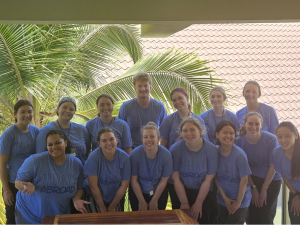
I was awarded a TAG grant to attend a trip through Therapy Abroad in May 2025. Therapy Abroad is a program that hosts international trips for American students, specifically geared towards future occupational therapists, physical therapists, and speech therapists. The particular trip I attended took students from across America to Punta Gorda, Belize, to host speech ttherapy camps for students from schools without access to speech therapy of any kind.
Punta Gorda is in the Toledo District of Southern Belize, right on the edge of the Caribbean Sea. It is one of the poorer areas of Belize without much access to formally trained special education teachers. In that area of Belize, disabilities are often shamed. The parents often feel guilty or look down upon their child if they are born with or develop disabilities. As such, many of the kids with language or learning disorders are grouped into a separate classroom. Unfortunately, they tend to be labeled as “bad kids” because they do not pay attention or they communicate through hitting instead of using their words. These kids often stay stagnant because the normal way of teaching is not accessible to them. On this trip, we performed speech therapy with the students, as well as modeled for the teachers on how to teach kids who communicate differently.
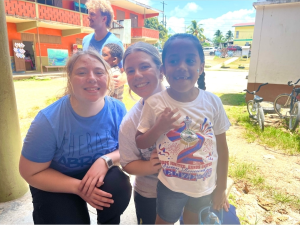
I had the chance to work with three clients, all with different disorders and difficulties, alongside my teammates. Jahson had Type 3 Autism, was non-verbal, and had delayed interpersonal skills. He quickly became notorious for stealing the other kids’ toys and refusing to return them. When he became frustrated or upset, he hit us hard, knowing it would create a reaction in us. He did not like playing with other people and would often isolate himself. His teachers in the past had let him do this to avoid getting hit, which had only reinforced the aggression. We worked with Jahson on parallel play, sharing, and self-regulation.
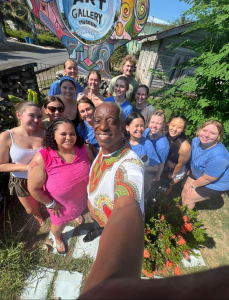
Next, I worked with Victor. We suspect Victor has Williams’ syndrome, a genetic disorder that affects physical characteristics in a way that makes their face smile when at rest, usually because of hypertension in the upper lip. We were unfortunately not able to test him for this as we did not have a licensed geneticist with us on the trip. Victor was also very soft-spoken, although he was not shy. We discovered he communicated very well when given AAC devices. AAC devices, or Augmentative and Alternative Communication devices, are an alternate form of communication used when the client is non-verbal or has issues communicating orally. AACs can be low-tech, such as pictures on a piece of paper which the client points to, or high-tech, such as an iPad that reads words aloud after an image is selected. We worked with Victor on increasing his volume, utilizing low-tech and high-tech AAC devices, and solving basic logic problems.
Lastly, I worked with Kyanni. Kyanni has moderate hearing loss, mainly not being able to hear lower pitches. This caused learning delays because of the inability to fully hear what the teacher was saying. She also seemed to know less than most kids her age. On the first day, when we asked her, “What animals live in the ocean?” She answered “Fish!” When we asked her what else lives in the ocean, she seemed stumped, eventually saying, “Other fish!” We worked with Kyanni on spontaneous generation, answering open-ended questions, and following complex directions.
Robert T. Kiyosaki is credited with once saying, “Be not afraid of growing slowly; be afraid only of standing still.” While this quote is true in any area of growth and change, it is especially true in pediatric speech therapy. Each of the kids we worked with had areas they struggled with. When doing speech therapy, we celebrate the small wins because we personalize our therapy to each client. We celebrated when Jahson shared a few small toys with me. We celebrated when Victor told an entire story using his AAC. We celebrated when Kyanni answered the question “What lives in the sea?” with at least ten different animals. To parents and teachers, these successes may seem trivial. However, if this amount of change happened in just a few days, imagine what could happen with a whole summer of speech therapy. There are Therapy Abroad speech therapy groups going to Punta Gorda, about once every two weeks, for the rest of the summer to work with the same kids. While I may not see the end result, I got to be a part of these kids becoming better communicators, meaning their disability will not deter them from achieving their dreams in the future.
Alexandria Burgess
Punta Gorda, Belize
TAG grant, May 2025
Communication Science and Disorder major