
Overview
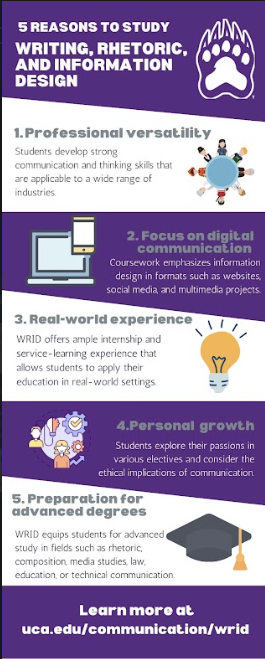
The major in Writing, Rhetoric, & Information Design (WRID) prepares you to be a UX (user experience) professional, grant writer, social media manager, online content creator, technical/professional Writer, editor, teacher, and other roles involving writing, information design, and publishing.You will also have a strong foundation for graduate study in rhetoric, composition studies, law, business, technical and professional writing, journalism, and education.
WRID delivers a dynamic range of courses in rhetoric and composition, technical and professional writing, information design, and the teaching of writing. Rooted in real-world communication, WRID equips you to craft purposeful, usable, and accessible messages through persuasive writing, visual design, and digital media across a variety of professional settings. Distinct from the literary and personal perspectives of creative writing, WRID stresses the impact and strategy of both writing and information design for use in public and private sectors of work.
In short, WRID prepares you to thrive in today’s human-centered communication networks—spanning careers in business, industry, government, and nonprofit fields. The program also plays a key role in advancing the university’s commitment to strong writing and critical thinking through general education writing courses. See our WRID Career Paths flyer on flexible WRID-related careers of today and tomorrow—then come track with WRID! Declare a WRID major or minor today!
- Bachelor of Arts: Major Tracks
- Technical & Professional Writing
- Writing Studies
- Minors (21 hours)
- Technical & Professional Writing
- Writing Studies
- Program Coordinator: Dr. Kyle Mattson
WRID Information & Opportunities
- Courses
- Academic Maps: PW | WS
- Technical & Professional Writing Major Checksheet
- Technical & Professional Writing Minor Checksheet
- Writing Studies Major Checksheet
- Writing Studies Minor Checksheet
- WRID Flyer: Flexible Career Paths!
- Become a paid tutor for the Center for Writing & Communication!
The WRID Faculty. We’re here for you!
More about WRID!
Students in either track of the WRID major are required to complete a track-specific contract early in their coursework and submit a corresponding graduation portfolio in the semester prior to graduation.
For questions about the WRID major or minors, the track-specific graduation contract, or the graduation portfolio, contact the WRID Program Coordinator, Dr. Kyle Mattson, or any of our WRID faculty. We’re here for you!
TRACK 1: Technical & Professional Writing, Major & Minor
Technical & Professional Writing Contract & Portfolio Instructions
Technical and Professional Writing, or Track 1 of the WRID major and minor, gives you practical and theoretical experience as writers working to get things done. Whether planning and designing digital or print-based projects or contributing to and curating knowledge for diverse social media platforms, professional writers design information for use and accessibility.
Professional writers produce websites and blogs, training manuals and infographics, reports, proposals, and white papers, among numerous other workplace genres, projects, and products. Students following this path often pursue futures in industry, government, or non-profit sectors. Recent graduates of this track have worked as writers and curators of niche content for companies across Central Arkansas and Greater Little Rock.
The Technical and Professional Writing track is designed to provide theoretical and practical experience in developing communication that works, that is to say, communication that people use (to make decisions, to get work done, to get information, etc.) such as social media, websites, white papers, training materials, reports, and proposals for a 21st-century audience.
TRACK 2: Writing Studies, Major & Minor
Writing Studies Contract & Portfolio Instructions
The Writing Studies track, or Track 2 of the WRID major and minor, gives you a breadth of experience in rhetoric, composition, professional writing, creative writing, and linguistics. While pursuing an interdisciplinary understanding of these many areas, you will enhance your writing skills in a range of academic, and creative writing genres.
Writing studies majors and minors study the diverse purposes and practices of textual production and the different social and cultural contexts of writing. Students in the Writing Studies track value the diverse purposes and practices of textual production, whether through rhetorical analysis, creative exploration, or multimodal compositions and presentations.
The Writing Studies track is designed to provide substantive opportunities to explore the histories, theories, and circumstances in which written text is created and used, including social history of writing as a technology; theories on writing and identity, ideology, and politics; writing as a mode of expression, cognition, and memory; and writing as recognizable form and genre.
WRID Internships
Writing, Rhetoric, & Information Design Internship
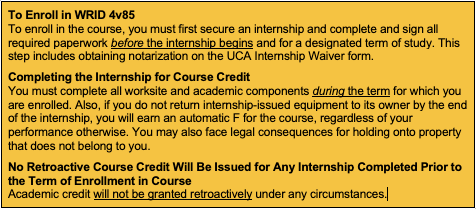
WRID 4v85, Internship in WRID. Reminder of in-term requirements (ver. 8-16-25).
WRID Directed Studies
Writing, Rhetoric, & Information Design Directed Study
WRID Awards
Dr. Joanna Castner Post Outstanding Student in Writing, Rhetoric & Information Design
2025-2026 Grace Flannagin
2024-2025 Gillian Howard
Best Individual Project in Writing, Rhetoric & Information Design
2025-2026 Madison Prichard
2024-2025 Zachary Walter
Best Team Project in Writing, Rhetoric & Information Design
2025-2026 Bailey Sims, Cole Morrison, and Nathan Weaver
2024-2025 Grace Flannagin, Will McDonald, and Zachary Walter
WRID Awards (2015-2016 through 2023-2024)
Scholarships
Apply here for scholarships listed below.
Donis W. Ford Memorial Book Scholarship
For full-time junior or senior African-American students majoring in English, African-American Studies or Writing with a GPA of 3.0 or above. Consideration may be given to financial need.
Fred and Lillian Petrucelli Scholarship
For full-time students majoring in writing, journalism or theatre with a GPA of 2.75 or above. Selection shall be based on financial need, potential and academic performance.
John C. Rohweder Scholarship
For full-time undergraduate students who have completed 30 or more hours with a cumulative GPA of 3.25 or above. Preference is given to non-traditional students, students majoring in writing, or students pursuing a degree within the College of Arts, Humanities, and Social Sciences. Consideration may be given to financial need.