• Skip to primary navigation
  • Skip to content
  • Skip to footer
  • Skip to content
  • Skip to navigation
  • Skip to footer
University of Central Arkansas Logo

College of Health and Behavioral Sciences

Menu
  • UCA Home
  • Admissions
  • Academics
  • Campus Life
  • Athletics
  • Connect
  • About UCA
  • A to Z
  • CHBS Home
  • About Us
    • Dean’s Welcome
    • Associate Dean’s Welcome
    • Dean’s Office Staff
    • CHBS Advisory Board
    • CHBS Student Advisory Board
    • CHBS Committees
    • Learning Spaces
    • SIGNs- Significant and Important Good News
  • Departments
    • Communication Sciences and Disorders
    • Exercise and Sport Science
    • Health Sciences
    • Military Science and Leadership
    • Nutrition & Family Sciences
    • Occupational Therapy
    • Physical Therapy
    • Psychology and Counseling
    • School of Nursing
  • Living Learning Communities
  • Interprofessional Education
    • IPE Committee
    • IPE Subcommittees
    • IPE Curriculum
      • IPE Competency Levels
      • IPE Introduction
      • IPE Immersion
      • IPE Competence
      • IPE Honors
    • Links/Resources
    • R.E.A.C.H IPE Conferences
  • Giving to CHBS
  • Social Media
  • IHSB Classroom Request Form

IPE Curriculum

IPE Curriculum

Recognizing the diversity of IPE activities needed and desired by programs, faculty, and
students each department determines the level of proficiency their students should meet.


  • Number and level of events attended by students is determined by each program.
  • IPE learning activities are embedded into curricula for each profession.
  • IPE Objectives and activities are placed in course syllabi.


Student should have learning experiences providing training in all 4 of the IPEC Core
Competencies. (1)

  • Circular diagram illustrating interprofessional collaboration competencies. The outer ring reads “Interprofessional Collaboration.” Inside are four colored segments labeled “Values and Ethics,” “Roles and Responsibilities,” “Communication,” and “Teams and Teamwork.” At the center, the text reads: “For the health of persons & populations across the continuum of care.” The design uses multiple colors to visually connect the four core competency areas.Teams and Teamwork – Apply values and
    principles of the science of teamwork to adapt
    one’s own role in a variety of team settings.
  •  Roles and Responsibilities – Use the knowledge
    of one’s own role and team members’ expertise
    to address individual and population health
    outcomes.
  • Values and Ethics – Work with team members to
    maintain a climate of shared values, ethical
    conduct, and mutual respect.
  • Communication – Communicate in a responsive,
    responsible, respectful, and compassionate
    manner with team members.


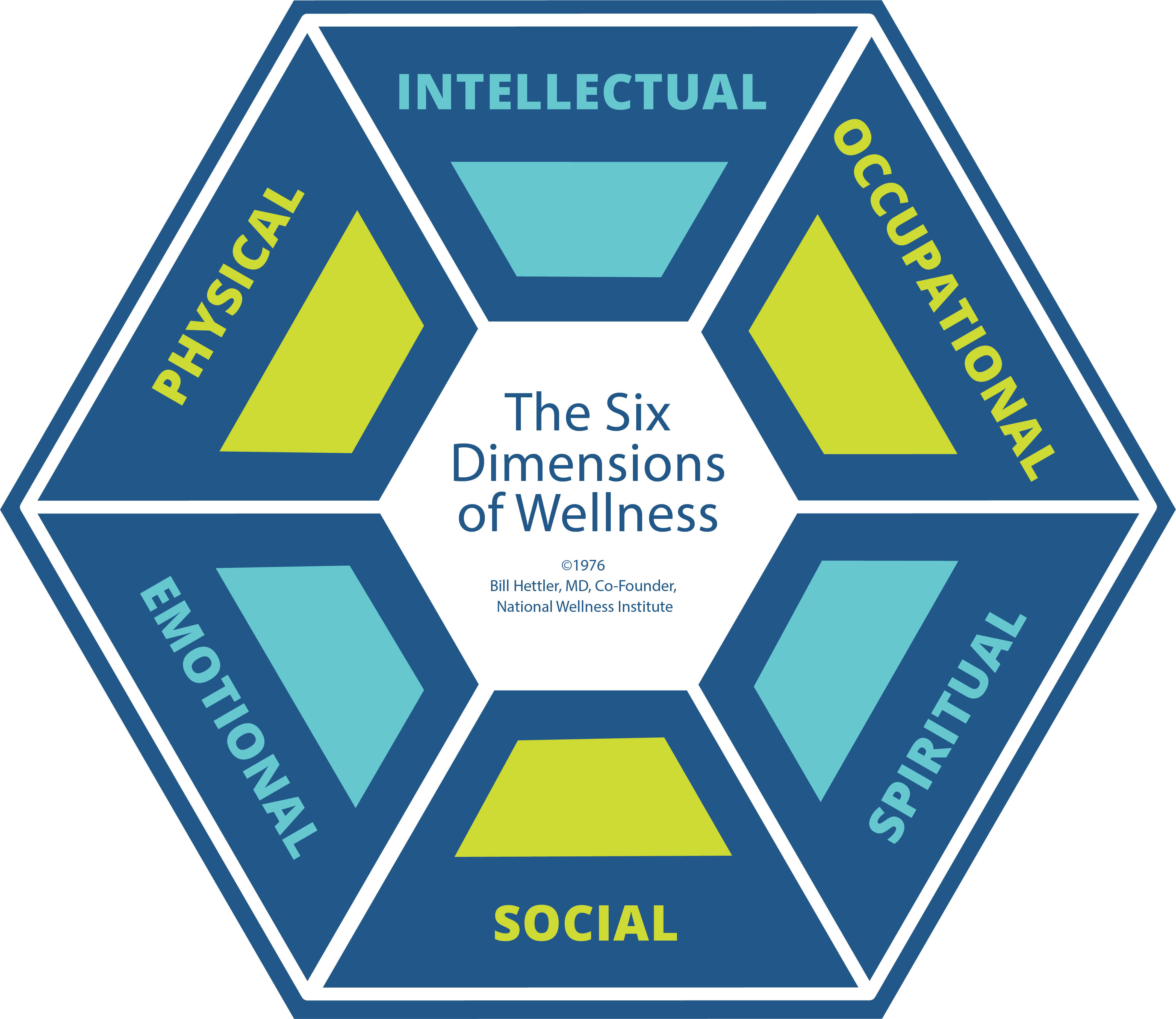
IPE activities should also take into account the following constructs:
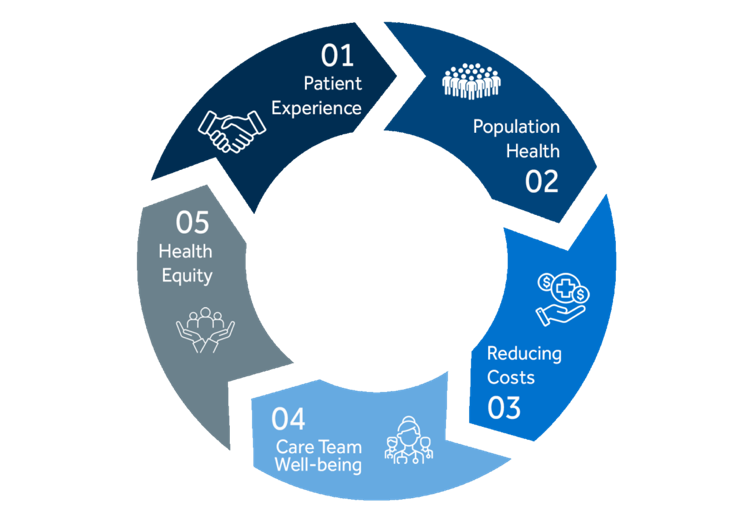
Circular infographic with five connected segments illustrating key healthcare goals. The segments are labeled: “01 Patient Experience,” “02 Population Health,” “03 Reducing Costs,” “04 Care Team Well-being,” and “05 Health Equity.” Each section includes a small icon and is arranged in a continuous loop, suggesting an interconnected approach to improving healthcare outcomes.

Quintuple AIM (2,3)

Hexagon diagram titled “The Six Dimensions of Wellness.” Each side of the hexagon is labeled with a different dimension: Intellectual, Occupational, Spiritual, Social, Emotional, and Physical. The labels are arranged around the edges with colored sections pointing inward. In the center, text reads “The Six Dimensions of Wellness,” with a smaller note indicating it was developed by Dr. Bill Hettler, co-founder of the National Wellness Institute.

Dimensions of Wellness (4)


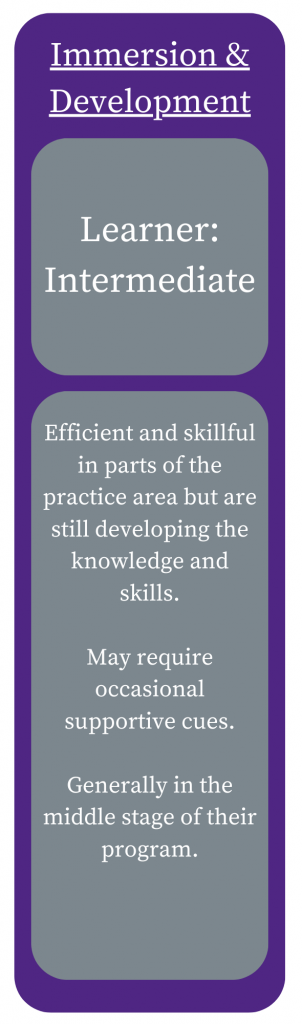
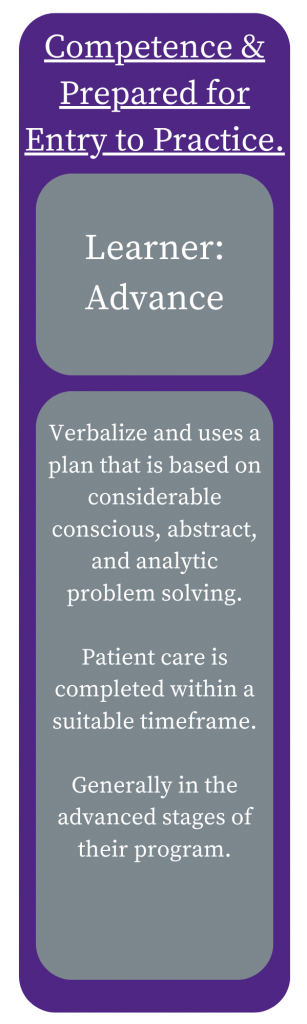
Levels for IPE activities, events, and courses (5): 
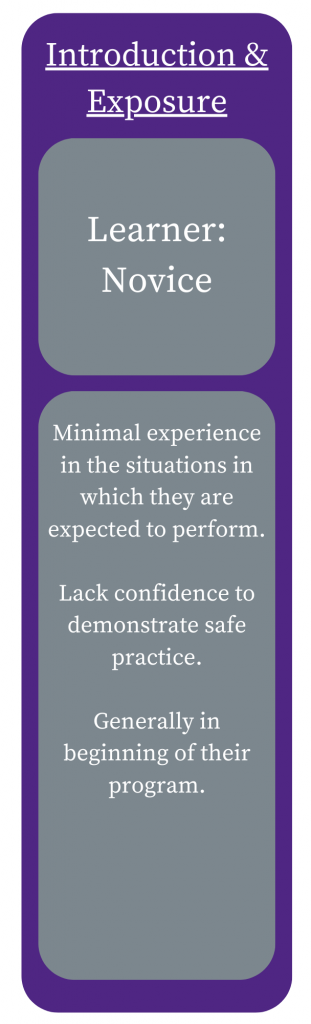
Vertical infographic with a purple header titled “Introduction & Exposure.” Below, a section labeled “Learner: Novice” appears in a gray box. A larger gray text box underneath describes characteristics of a novice learner: minimal experience in expected situations, lack of confidence in demonstrating safe practice, and typically being at the beginning of their program.Vertical infographic with a purple header titled “Immersion & Development.” Below, a gray box labeled “Learner: Intermediate.” A larger gray section describes an intermediate learner as efficient and skillful in parts of the practice area while still developing knowledge and skills, may require occasional supportive cues, and is generally in the middle stage of their program.Vertical infographic with a purple header titled “Competence & Prepared for Entry to Practice.” Below is a gray box labeled “Learner: Advanced.” A larger gray section describes an advanced learner as able to verbalize and use plans based on conscious, abstract, and analytic problem-solving, completes patient care within an appropriate timeframe, and is generally in the advanced stages of their program.

*With Interprofessional Honors

 IPEC Competencies – Leveled for UCA IPE curriculum


References:
1. Interprofessional Education Collaborative. (2023). IPEC Core Competencies for Interprofessional Collaborative Practice: Version 3. Washington, DC: Interprofessional Education Collaborative.
2. Nundy S, Cooper LA, Mate KS. The Quintuple Aim for Health Care Improvement: A New Imperative to Advance Health Equity. JAMA. 2022;327(6):521–522.
doi:10.1001/jama.2021.25181
3. https://www.chesshealthsolutions.com/2023/08/01/the-quintuple-aim-what-is-it-and-why-does-it-matter/
4. https://nationalwellness.org/resources/six-dimensions-of-wellness/
5. Charles G, Bainbridge L, Gilbert J. The University of British Columbia model of interprofessional education. J Interprof Care. 2010;24(1):9-18. doi:10.3109/13561820903294549


Footer

CHBS Address

IHSB 205
201 Donaghey Avenue
Conway, Arkansas 72035


Contact Information

Phone: 501-450-3123
Fax: 501-450-5503

Email: chbs@uca.edu

University of Central Arkansas · 201 Donaghey Ave., Conway, AR 72035 · (501) 450-5000
UCA is accredited by the Higher Learning Commission.
Report Web Accessibility Issue | Concerned About a Student? | Privacy
Copyright © 2026 · All Rights Reserved